On sale for the purpose of viewing beyond the limits of the rainbow
2016 (ongoing)
— This work reframes a photographic image as a contested proof. By placing its analogue negative on sale, it activates photography’s indexical promise within a culture of digital suspicion.
The image does not resolve doubt – it stages the desire for evidence as both a visual and an economic construct.
POSITIVE

NEGATIVE
VALUE
PROOF
On 20 May 2016, a rare atmospheric phenomenon briefly appeared over Naples: Mount Vesuvius encircled by a rainbow. The event was widely photographed and rapidly circulated online, where its veracity was as quickly called into question. Within a digital image economy shaped by manipulation and repetition, even direct visual evidence became subject to doubt.
This work originates from that moment of uncertainty. Rather than attempting to document or confirm the event, it displaces the question of truth onto the conditions of its verification.
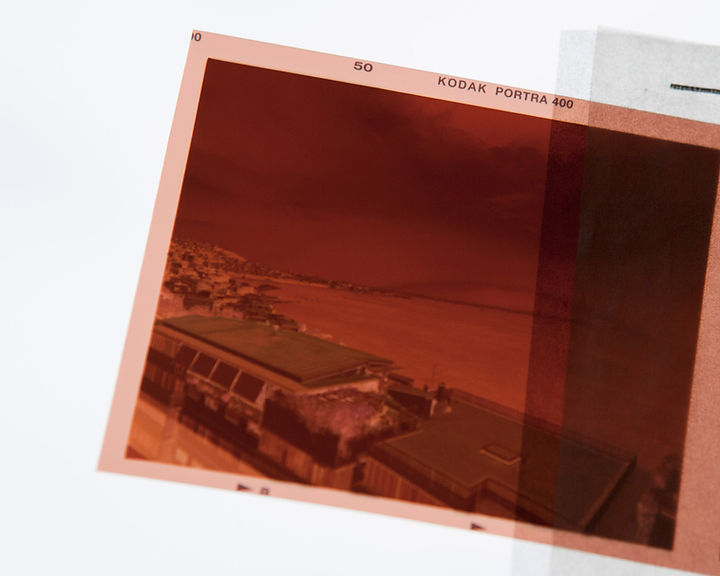
At the center of the project is the analogue negative from which the image is derived. Traditionally understood as photography’s primary index – its physical and chemical trace of reality – the negative is here reactivated as a contested object. While commonly associated with authenticity and resistance to manipulation, its authority is not restored but tested against a contemporary regime in which all images are potentially suspect.
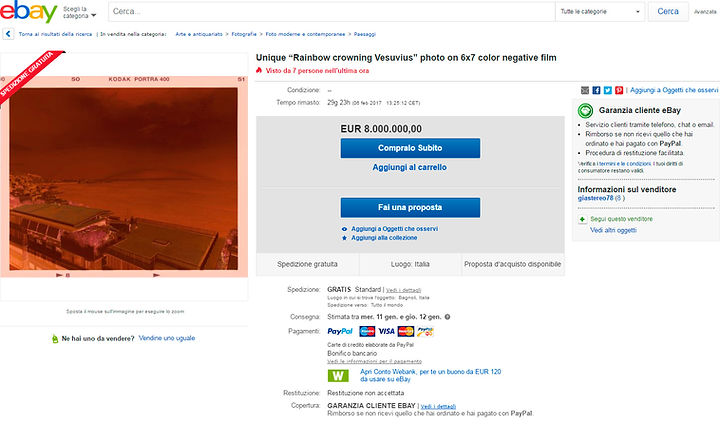
The negative is offered for sale on eBay at the price of €8,000,000,000. This move does not operate as provocation alone, but as a speculative device: economic value becomes entangled with the claim of truth, exposing how credibility can be constructed, transferred, and negotiated. Ownership becomes implicitly linked to the possibility of verification, while the uniqueness of the analogue matrix is set against the infinite reproducibility of digital images.
The work does not prove the event – it stages the desire for proof. In doing so, it reveals how the indexical promise of photography persists less as a guarantee than as a cultural expectation, one that continues to shape our relationship to images even in the absence of certainty.
Remaining active as long as the negative is on sale, Rainbow Crowning Vesuvius operates as an open-ended structure in which image, object, and market intersect. Suspended between evidence and fiction, it questions whether material traces can still function as proof, or whether they merely perform the illusion of it.
EDITION


The book contains a faithful reproduction of the analogue negative on Kodak Duraclear film, a Certified Fine Art C-print, and an archival documentation of the image’s media circulation.
It functions as a secondary stabilization of the work, translating the instability of the digital field into a controlled material object.
CIRCULATION
Selected international media circulation, 2016
—
“EIGHT MILLION euros”
— The Daily Mail (UK)
“is it really worth £6.7 million?”
— The Telegraph (UK)
“8 milioni di euro”
— La Repubblica (IT)
“on sale for €8 million”
— The Local (UK)
“negatyw za 8 mln EUR”
— Puls Biznesu (PL)
“PANTASTIS!!!”
— Harianriau (ID)
“Rp119 Miliar”
— Okezone (ID)
In the image On sale for the purpose of viewing beyond the limits of the rainbow by Giovanni Scotti, the eye-machine and the chemical support enclosed in the frame play as third-party subjects capable of producing an objectifying documentation of reality, as free as possible from any vision distorted by anthropological subjectivism. With analog photography, there is a necessary mediation between human being and the thing in order to create a detachment between emotion or feeling and the real world. Only with the frame, in the indifferent form of material support as a value of documentation, can one contemplate a principle of visual reason that is impossible to manipulate, alter, sugarcoat, or adulterate.
Cosimo Flavio Gioia
Philosopher of the Unimage
Excerpt from the essay “Immagine e materia dello sguardo”